POPULAR ARTICLES

Showing posts with label affordable. Show all posts

Tuesday, March 3, 2015

Looks Like Mud. Tastes Like Heaven.


"I was just trying to catch a few eels to make an eel stew. Though, I suppose I won't get any, and you wouldn't like it if I do," said the charmingly despondent Tom Baker as Puddleglum the Marshwiggle in the BBC production of C.S. Lewis' The Silver Chair. He continued, "it's against reason that you should like our vittles... Food for Wiggles is poison for Humans."

Seongka'ne, one of Pyeongtaek's most
 popular restaurants
As a young boy I used to be thrilled by the glorious taboo of Puddleglum's muddy, eel stew. Fast forward a couple decades and down the street from my first apartment in Korea stood Seongka'ne Keunjip Chu'eo'tang (성가네 큰집 추어탕), a stew restaurant. And not just any stew restaurant. On its yellow sign were what appeared to be two, big, happy eels. I had found Puddleglum's stew. The restaurant is one of Pyeongtaek's busiest. And despite Puddleglum's negativity, there is every reason
why you should like their vittles.

Seongka'ne actually doesn't serve eel stew. They serve chu'eo tang (추어탕). The translation is, "mud loach stew." Yes, that actually sounds worse than eel stew, but it is far from poisonous. In fact, is is one of the most delicious things I have ever tasted in Korea.

Mud loaches (also called mi'ggu'raji 미꾸라지 in Korean) are small, eel-like, freshwater bottom feeders. Because they can breath air as well as water, they are sometimes found in mud. However, while the stew may look like mud, it tastes like anything but.

Chu'eo tang's flavor is a little hard to pin down. If you tried a bowl of it without knowing what it was, you would never suspect that it was made out of pulverized fish. It is definitely savory and rich in the manner of dark poultry. And it lacks the greasiness of red meat. If someone had told me it was the stew of a small mammal or of some wild bird like a pheasant or quail, I wouldn't have questioned them.


Dolsotbap transforms into sung'nyung
The texture is where the dish suffers a bit. Overall it is just what you might expect from a thick stew made from ground fish. It's a little creamy. However, it's a bit grainy too. And sometimes there is a mildly sandy crunch to get through. It is very light, so I am not sure if this is actual sand from the creature's gut; grains of tiny, ground bones; or one of the seasonings in the stew. Luckily, the effect is so mild and the flavor is so good, it is easy to ignore.

Like many Korean stews, chu'eo tang is great with a bowl of rice. The restaurant gives you two options: stew with gongi bap, that is with a plain bowl of rice; or stew with dolsotbap (돌솥밥): a large, hot bowl of rice. The first is 6,000 won. The latter is 7,000 won. The advantage of dolsot bap is that after you scoop out your rice you can pour water in the bowl and make a toasty rice soup called, sung'nyung (숭늉).

Rice is so essential to the meal that a sign in the back of the restaurant even gives directions on how best to enjoy it with your stew. According to the sign, for the very best experience, you should put half your rice in your stew and mix the other half with the chopped green chillies and some preserved, spicy oyster called eoli'guljeot (어리굴젓). The rice definitely fortifies the stew, stretching it out and making it more filling. And mixed with the preserved oysters, the rice assumes a taste distinctly reminiscent of the ocean. Having grown up by the sea, I found the oceanic flavor enjoyable. However, the NetBot, EatKorea's robot taste tester from suburban California, was not so keen on it.

A variety of side dishes including
eoli'guljeot (center bottom)
The sign in the back of the shop talks about more than the rice. Chu'eo tang apparently is a nutritious health food. The fish, the sign claims, are like nutritional supplements. The whole fish is ground up bones, guts and all. And because of this it is said the stew contains lots of calcium and protein among other less believable nutrients. The claims don't stop there. Like most Korean health foods, it is believed that the fish improves a person's sexual stamina. Who can really say? But at very least, this satisfying meal does provide enough strength to tide one over until dinner.

Seongka'ne Keunjip Chu'eo'tang is extremely busy. Do not be surprised if you have to wait to be seated. They are open from 10am to 9pm. To get there take the 50 or 20 bus from Pyeongtaek Station to the City Hall stop in front of Lotte Mart. When you get off the bus, backtrack to the intersection that the bus passed through just before the stop. When you get to that intersection, turn left toward Lotte Mart. Walk straight and continue past the store until you see a CU convenience mart on your right. Seongka'ne will also be on your right across from CU.

(Thanks to Park Junsik for obtaining the open hours)


지도 크게 보기
2015.3.3 | 지도 크게 보기 ©  NAVER Corp.


read more "Looks Like Mud. Tastes Like Heaven."

Monday, March 2, 2015

The House of Mountain Vegetables


Koreans have a passionate love of the mountains. It is really hard to ignore. Just get on any public transportation and you're bound to see aged, backpack bearing Koreans armed with hiking poles and regaled head to toe in colorful synthetic blends. The call of the mountains goes well beyond open spaces and fresh air, though. Korea's mountains are closely associated with fresh, natural, and even curative veggies. It is this reputation for fresh, healthy vegetables that Sanchaewon (산채원), a "mountain-veggie" restaurant, takes full advantage of.

The interior is very clean and strangely airy and bright for being indoors. It is almost as if the restaurant was perched on a mountainside instead of its real location on an ugly, developing street near Lotte Mart. The sliding doors use a homemade pulley and weight system that uses gravity to close them. The heavy, ceramic bowls are crafted to appear to have been hewn out of stone. Herbal, solomon's seal tea (dung'gul'le cha 둥굴레차) is poured out of thin, aluminum pots like those found at old and traditional restaurants. A lot of effort went into making the restaurant look and feel like a fresh, wholesome, mountain abode, and their food certainly enforces the effect.

Their mostly vegetarian menu centers around three rustic foods: mountain veggies (산채), deo'deok (더덕), and hwangtae (황태).

The mountain veggies at Sanchaewon include a forest glade full of fresh and prepared veggies: bracken ferns (gosari 고사리), shitaki mushrooms (pyogobeoseot 표고버섯), radish tops (si'laegi 시래기), soybean sprouts (kongnamul 콩나물), spinach (sigeumchi 시금치), lettuce (sang'chu 생추), kimchi radish (mu saengchae'namul 무생채나물), and pimpinella (cham'namul 참나물). Normally these are banchan (반찬), side dishes. But in Sanchaewon's "sanchae jeongshik" (산채정식), it is the main course. Add a hot stone bowl of rice (dolsot bap 돌솥밥), and these veggies become a palette for designing your own bibimbap. Sanchae jeongshik can only be ordered for at least two people. And at 11,000 won per person, it is a lot more expensive than the alternative — ordering a bowl of bibimbap. Yet, whether you order their vegetable platter or a 7,000 won bowl of bibimbap, you can depend on the food being fresh and handmade. I've been eating there since they opened a few years ago, and their bibimbap has always been the best in Pyeongtaek. 

Deo'deok is the root of a plant that few in the West, except perhaps avid gardeners, herbalists and botanists would recognize. Have you heard of Codonopsis lanceolata, also known as bonnet bellflower? It sounds poisonous, but this plant is supposedly healthy for you, promoting immune and mental health

"It's like real nature," my friend Jerry Park said about grilled deo'deok in general. "You can smell the freshness of the forest."

Hwangtae is walleye pollack that is hung on wooden frames and left to the mercy of the winter elements. In time, the extreme weather naturally freeze-dries the fish. It looks similar to how some Native American tribes traditionally preserved their fish. 

Every time I have visited Sanchaewon I have been craving bibimbap, so I haven't tried their deo'deok or hwangtae. I have tried them at other restaurants, though, and in my experience they are more suited to broader palates. Deo'deok has a strong rooty flavor reminiscent of something a groundhog in a field of wildflowers might enjoy. And hwangtae, though not especially fishy, can be chewy in a way Westerners don't normally associate with fish. I like them, but then again, I like almost everything. 

Sides: (clockwise) jeon (전), jeotgal (젓갈), 
mul kimchi (물김치), eolgali kimchi (얼갈이김치),  
doenjang guk (된장국) , 
ganjang chojeol'im  (간장초절임)
Whether you order vegetables, weird roots or preserved fish, as at most Korean restaurants, you can expect to find a broad range of homemade side dishes. The sides dishes at Sanchaewon change a little from time to time. For example, back in December my bibimbap included white kimchi (baek kimchi 백김치) and seasoned, boiled daikon radish (Jolim'mu 조림무). However, when I visited last week the side dishes had changed. Instead of boiled radish and white kimchi, my meal had spicy pickled radish (간장초절임) and water kimchi (물감치). While the sides can change, you can always expect an unusually vegetal bowl of doenjang guk (된장국) and some kind of kimchi.   

Sanchaewon is open 10am to 10pm. They are pretty easy to find. Take the 50 or 20 bus from Pyeongtaek Station to the City Hall stop (shi'cheong 시청) in front of Lotte Mart. When you get off at the stop, backtrack to the intersection and turn left toward Lotte Mart. Walk past the store and keep on going straight until you see a CU mini-mart on your right. Go down the street beside CU. Sanchaewon will be on your right, across from the dirt lot behind the mart.  

(Some reporting by Park Junsik)


지도 크게 보기
2015.3.2 | 지도 크게 보기 ©  NAVER Corp.


read more "The House of Mountain Vegetables"

Wednesday, February 25, 2015

Bulgobimbap Envy


Yuk'ssam Naengmyeon (육쌈냉면) is a chain restaurant with at least 35 locations throughout Korea, including one in downtown Pyeongtaek. Naengmyeon, a kind of cold noodle soup, is part of their name, but that is not what I go there to eat. I go there for their bibimbap — a bibimbap served with a side of the most delicious, smoky, tender bulgogi. 

Even the NetBot, Eat Korea's robot taste tester, is enamored with their "Bibimbap Sut-bulgogi" (비빔밥 숯불고기). A former pescetarian, bibimbap pushes all the right buttons for her. Plus, being pickier about meat than most robots, she admitted she would rather eat a plate of Yuk'ssam Naengmyeon's sut-bulgogi than a full steak. As the only natural meat eater at Eat Korea, I am only a little inclined to disagree. Yuk'ssam has some really fantastic bulgogi. It isn't a substitute for a bloody steak, but I'm not a robot taste tester. 

Frankly, the bulgogi is what makes Yuk'ssam Naengmyeon stand out. Their main menu features naengmyeong, bibim-naengmyeon (cold noodles with veggies and no broth) and bibimbap. And each comes with a wooden dish of their signature meat. It has been some years since I ate their naengmyeon, but their bibimbap, a very affordable 6,000 won, tastes especially fresh. 

It is hard to ruin bibimbap, but it isn't easy to take a normal dish like bibimbap and make it extraordinary. The bulgogi does this. It takes this simple and delicious dish and makes every beef-bimbap'd bite a treat. The bibimbap is so improved by the meat that NetBot and I become quite protective of our meat portions. The meat is served on a single slab of wood, so portioning is subjective. There is enough to accommodate two people, but it is so good we are eventually seduced by the promise of a slice of bulgogi on every spoonful of bibimbap. The dangers of bulgo-greed are real. You never know when you'll have to correct the balance and steal some meat from the other side of the table. 

Yuk'ssam Naengmyeon serves lunch and dinner, opening at 10 am and closing at 10 pm. The service is decent. The place is clean, and it has lots of large windows offering a nice view of the street to diners. 

To get to the restaurant from Pyeongtaek Station, first hold out your right hand palm up and imagine the five streets in front of the station as the five fingers on your hand. Cross the street and walk down the index finger. You should be on the right side of the road. After one block turn right. You should see Yuk'ssam Naengmyeon not too far ahead of you on the second floor of a corner building.  

지도 크게 보기
2015.2.25 | 지도 크게 보기 ©  NAVER Corp.


read more "Bulgobimbap Envy"

Thursday, February 19, 2015

Authentic Sanuki Udon Handmade at Takumi

Freshly cut sanuki udon noodles at Takumi

Udon noodles are sensitive things. On no two days is a batch of homemade udon exactly the same. They are like a barometer, changing with the passing sun, the falling rain, and the blowing wind. To the novice hand these subtleties are hard to tell. But after a decade of crafting these eminently Japanese noodles, it is said that one can note their changing character.

This is one of the many things that Jo Hyeong-chan (조형찬), 47, learned while studying the art of making noodles on the Japanese island of Shikoku. He has been making udon for three years now at Takumi (타쿠미), his little noodle shop in Pyeongtaek. But already he can feel the differences that his old noodle sensei told him about, and it shows in his food.


A bowl of Takumi Udon

Hyeong-chan doesn't make just any udon, though. He makes sanuki udon. 
Sanuki udon is not the udon most Westerner's initially think of when they think of udon. This is not the side dish commonly found with your tempura or sushi at many Japanese restaurants. At Takumi sanuki udon is a whole meal, a meal that originated in Kagawa Prefecture, on the island of Shikoku in Japan. The name comes from the prefecture's old name of Sanuki. Of the main islands, Shikoku may be Japan's smallest, but its udon is one of the country's most popular.   
  
According to a hand-written note on the wall of the restaurant, Sanuki udon is different from other udon in its emphasis. Standard udon emphasizes the broth, called dashi in Japanese. However, sanuki udon emphasizes the noodles. The result is a long, thick, square noodle of remarkable flavor and texture. This is not to say the broth is flavorless, though. At Takumi, a lot of effort goes into the broth which is a complex mix of kelp, anchovies and other ingredients. But in their udon the broth doesn't overpower the noodles but supports them.


Jo Hyeong-Chan with his noodles
Hyeong-chan, a friendly man with mirthful eyes, is very particular about his udon. While we spoke he lamented the general state of Korean noodles which can contain lots of food additives. His noodles, though, are surprisingly simple for something so delicious. They are made of flour, water and salt — nothing more. He prepares the dough fresh every morning before opening. As needed, he rolls them out with long poles on a floured, wooden counter behind the cash register, taking his time like an expert potter as he feels for the proper thickness. In fact, this pottery degree holder, says making udon really does feel like making pottery. You can even see some of his inedible work, tiny cups and bowls, on display on the wall opposite the register.

Like restaurants on the other side of the East Sea, Takumi is long and narrow, squeezing at most 15 people and a clay bowl of koi into the cozy space. Every day from 11:30 am to 9:00 at night, except Mondays when the restaurant is closed, lunchtime brings crowds of hungry Koreans into the small space. Though cramped, few elbows are rubbed as patrons huddle over their bowls, completely immersed in their meals, breaking the quiet only while on their way out as they wish the cook, "Jal meok'eo ssumnida" (
잘먹었습니다) — a complement expressing that they really enjoyed the meal.


The interior of Takumi was designed
 and built by Hyeong-chan.
The restaurant is divided by a handmade bar crafted by Hyeong-chan himself, who left a successful career in construction to make udon. The bar separates the kitchen from the dining area, allowing noodle slurping patrons the opportunity to witness Hyeong-chan at his craft: steadily turning a pale block of dough into long strands of raw udon noodles that ultimately become a variety of delicious soups that range in price from 5,000 to 8,500 won.

In traditional Japanese style, the main menu hangs in wooden bars on the wall, offering many twists to popular Western expectations of what udon soup is. There is, of course, Kake Udon (가케우동), the standard udon arrangement. But there is also the house special, takumi udon (타쿠미우둥). It is served in a hot bowl with slices of beef, green onions, chives, chili peppers, and shiitake mushrooms. Feeling exceptionally hungry? Get some extra protein with donkas udon (돈까스우동): udon with fried pork cutlet. Other styles include twigim udon (튀김우동) and yubu udon (유부우동): udon with tempura and udon with fried tofu. Every bowl uses only fresh ingredients and, for the most part, only those sourced locally from Korea. An aspirant of complete self-sufficiency, Hyeong-chan said that ideally he would like to grow and mill his own wheat for his udon. However, that not being possible, he has to make due with Australian flour. 


A bowl of donkas udon.
Takumi has only been around for three years, but its story began five years ago with a movie. For years Hyeong-chan dreamed of owning his own restaurant, but it wasn't until he downloaded the Japanese film, Udon, a dramatic comedy centered around the sanuki variety of the dish, that he found his inspiration. Further motivated by the thrill of a new craft, he left his construction job and moved to his aunt's home in Osaka. For a whole year he commuted five hours a day, three days a week to the "Sanuki Udon" school in Kagawa Prefecture and learned the ways of the venerable noodle despite not speaking much Japanese. The language barrier wasn't a problem, he said, because the physical nature of making udon made it easy to learn by watching. After earning his Sanuki Udon certification, which is proudly hung by the door to his restaurant, he returned home to Korea.

Given the level of craftsmanship at Takumi and the unique nature of the food, its location is somewhat of an oddity. The restaurant would not be out of place in the hipper parts of Seoul or Busan, but Takumi isn't located in downtown Pyeongtaek. It isn't even located in the up and coming night-life scene of,  Jo'gae'teo (조개), down from Sosabol Stadium. This authentic udon noodle shop sits across the street from a Highway Mart grocery store, buried in a sleepy commercial area that is hidden from the main street behind aging apartment complexes in Vision-Dong (비전동). 

When asked why of all places he chose that unassuming spot to set up shop, Hyeong-chan said it was for his son. Before moving to Pyeongtaek his family lived in Anseong. There his son, a middle schooler at the time, had trouble with this one bully. To protect his son and keep a close eye on him, he moved the family to Pyeongtaek, and put his son in a new school near the shop. 


Today his son is a high school graduate, eliminating the need for Takumi to be so off the beaten track. Hyeong-chan, however, assured that he has no plans to move his shop or give up the craft. In fact, he feels the opposite. Whatever skill he takes up, be it mechanics, carpentry, or pottery, he pursues it until he masters it. His noodles are exceptional, but he doesn't feel like he has perfected his craft yet. When he has completely mastered the art of sanuki udon, only then, he says, will he consider moving on to something new. 

To visit this hidden gem, take a bus to New Core Outlet from Pyeongtaek Station. The New Core busses will have a board on the bottom left corner of the windshield saying, "New Core" in Korean: "뉴코아." The New Core stop is in front of a Samsung electronics store. Walk down the street to the big intersection. There should be a BYC on your right and a Daiso on the opposite corner. You need to get to that Daiso. When you get there, walk down the tree covered sidewalk. You will pass NewCore Outlet on your left across the street. Take a right at the next intersection you come to, and walk for two blocks until you see a large protestant church. Turn left at the church, then walk straight for a couple more blocks. Takumi will be on your left. 


- Thanks to Park Junsik who contributed to this article as an interpreter. 

지도 크게 보기
2015.2.19 | 지도 크게 보기 ©  NAVER Corp.


read more "Authentic Sanuki Udon Handmade at Takumi"

Friday, January 30, 2015

Shabu-Shabu Meets Summer Rolls


Shabu-Shabu is originally from Osaka. He isn't very traditional, but like his nation, he is neat and tidy and creative. More than that, though, he is very health conscious. Because of his health concerns he eats lots of fresh veggies and boils his meat instead of roasting since it's better for his heart.

Gỏi Cuốn is from Vietnam. Her English name is Summer Rolls. Despite the weight disparaging nickname, she is extremely lean. She has a fresh and upbeat personality, and, like Shabu Shabu, she takes care of her health eating veggies, seafood, and bits of meat wrapped in rice paper. 

Somewhere the two met in Korea, and with so much in common, an instant love story was born. You can experience it for yourself at Ssamchon Shabu Shabu (쌈촌샤브샤브) in Pyeongtaek. 

Shabu-shabu is extremely popular in Korea, and Pyeongtaek is no exception. There are at least nine shabu-shabu restaurants in the city. And Ssamchon Shabu Shabu is unarguably one of the top three. Since it opened a couple years ago, it has been a popular lunch or dinner location not just for Koreans but for City Hall area expats. It has a perfect rating on Naver. And it is safe to say that, over the last two years, the NetBot and I have eaten there more than at any other restaurant in Pyeongtaek. If you include times with our friends, we must have eaten there at very least 36 times. 

The draw of the place is simply great shabu-shabu mixed with summer rolls and the fun of making your own food. 

As at any shabu-shabu restaurant, a great big pot of spicy or plain broth is set to boil, and a platter of fresh veggies and shaved beef is laid out along with a sauce dish. Ssamchon, though, upps the ante by providing a broad array of fresh veggies, lots of quality beef, three unique dipping sauces and rice paper with which to craft your own summer rolls. And that is just the base meal. Variants include samgyeop-sal, grilled duck, or fresh seafood. The table gets really crowded with dishes, but it's completely worth it especially when the basic layout is only 10,000 won for lunch and 3,000 more for dinner. 

After you run out of meat, you can pour a bowl of rice noodles in the broth for the second course of the meal. And when you run out of noodles your waiter will use the remaining broth to make a pot of savory, Korean rice porridge called juk (죽). Second and third courses are not unusual at shabu-shabu restaurants. However, the taste at Ssamchon is just so far above the other places. And where else can you make rice noodle and porridge summer rolls?

Even Eat Korea's robot taste tester, The NetBot, adores the place. Programed by a small robotics company in California, her designers were very dedicated to healthful living through smart diet choices. Naturally this mentality was deeply encoded in her operating system. Plus, while she was not programmed to cook, the process at Ssamchon is very easy. So easy even a NetBot can do it. 

Ssamchon Shabu Shabu has locations in Pyeongtaek and Anjung-eup. However, like so many restaurants we have reviewed lately, the one we visited is really close to Pyeongtaek Lotte Mart. To get there from Pyeongtaek Station, take the 50 or 20 bus to the Pyeongtaek City Hall (평택시청) stop. It's in front of Lotte Mart. Walk towards Lotte Mart. Go past the side entrance with the giant pomegranate statue and keep walking straight. Turn left at the first intersection. Ahead of you there should be a park on your left and a foot bridge stretching over the road. Opposite the park next to the footbridge is TeaOreum, a cafe with great bubble tea and a host of traditional and unique Korean herbal teas. Ssamchon Shabu Shabu is on the second floor of the same building.


지도 크게 보기
2015.1.30 | 지도 크게 보기 ©  NAVER Corp.


read more "Shabu-Shabu Meets Summer Rolls"

Thursday, January 29, 2015

"A Lot of Buckwheat for Your Buck" at Uiryeong

Yangji sogukbap (양지소국밥) at Uiryeong Buckwheat Noodles

Buckwheat is not wheat. It's not a variety of wheat. It's not even a grain! ...well, if you're a botanist. 

But it is the feature ingredient at Uiryeong Buckwheat Noodles (의령소바) near Pyeongtaek Lotte Mart. 

Everything there contains buckwheat, also called soba (소바) or, more commonly, memil (메밀) in Korea. From noodles to mandu and even tea, everything has buckwheat at Uiryeong.

The place is primarily known for their unique, thick noodled naengmyeon (냉면) and bibim naengmyeon (비빔냉면). These dishes, cold noodle soup and cold noodles with veggies, typically have noodles so thin you can sew a traditional hanbok dress with them. But the buckwheat noodles at Uiryeong are almost as thick as udon, making these common dishes very different from the norm. 

Uiryeong's buckwheat jjin-mandu
This is January, though. The thermometer has been hovering just above freezing during the day and as low as 19 degrees fahrenheit at night. That's -7.2 degrees celsius for you metric people. Naegmyon is a summer dish. So lately my robot taste tester, The NetBot, and I have been taking advantage of Uiryeong's cozier fare. 

For almost a month now we have been taking delicious buckwheat mandu home for a light dinner, or to work for a quick energy boost. The dumplings have the right balance between squishy and firm. The fillings are savory. The buckwheat dough is tender. If I had to complain, I'd say they didn't pack enough danmuji (단무지) with the take-out box. Danmuji is yellow, pickled radish. Not everyone likes it. The NetBot doesn't. So I just eat hers. But if she did like it, there wouldn't be enough for both of us. 

Uiryeong serves two kinds of mandu: little jjin mandu (찐만두), and hefty wong mandu (왕만두). 3,500 won will buy eight of the little ones, and 5,000 won will buy five of the big guys. For a unique dessert, 3,500 won will also buy five whole-grain-tasting, red-bean-paste-filled buckwheat jjinbbang (찐빵). 

"That's a lot of buckwheat for your buck," said the NetBot.

Plain buckwheat noodles and rice
Most recently, though, we've taken to using Uiryeong's dishes as a palliative. The NetBot caught a mild virus, so we thought one of Uiryeong's hot soups would help reboot her system. The heartier soups there are a little more expensive. Naengmyeon (or Naengsoba as it is called on the menu) is only 6,500 won. But the strong soups, yangji sogukbap (양지소국밥) and golpeuchae galbi-tang (골프채갈비탕) are 8,000 won and 10,000 won respectively. We like saving money, so we got the first. It is pictured at the top of the page. Yangi sogukbap is a rich, spicy soup with lots of beef, leeks and radish. The flavor is really hard to distinguish from another rich, spicy, beefy Korean soup — yukgaejang (육개장). And like most Korean soups, it is served with a bowl of rice. However, since this is buckwheat land, they also serve a bowl of buckwheat noodles. Plain rice and noodles aren't meant to be eaten as they are, though. That would be too boring for your mouth. They are supposed to be mixed with the soup. 

What did the virus stricken NetBot think? "Oh that was delicious," she said upon finishing. "[but] I wish there was more meat, just 'cause the meat's so good."

Memil cha tastes like memil cha
If Uiryeong served just one thing, though, we'd be forced to choose their buckwheat tea, called memil cha (메밀차) in Korean. It is not uncommon for Korean restaurants to serve grain teas like corn or barley tea with their meals. But I had never experienced buckwheat tea before, so for weeks I raved that Uiryeong's tea was the best corn or barley tea I ever tasted. I couldn't decide which one it was. And then I saw the sign on the industrial coffee dispenser it came out of. 

Buckwheat tea is intensely yellow. It looks like pee after a day of not drinking anything, but it is truly the best "grain" tea I've ever had. It has a corn-like sweetness, but it doesn't taste like nonalcoholic beer, as some bottled corn and barley teas do. The true flavor is really beyond description. The best I can say is that it is delicious. The last time we ate at Uiryeong we drank two pitchers of it. 

"I'm very happy to drink tea now," said the NetBot done eating.

Getting to Uiryeong Buckwheat Noodles is simple. From Pyeongtaek Station take the 20 or 50 bus to Pyeongtaek City Hall (평택시청). Get off at the stop in front of Lotte Mart. Looking out from the bus, Lotte Mart is on your right. The stop in front of Lotte Mart is the City Hall stop. Keep walking down the street and take your first right. You'll come to an intersection and a park. Uiryeong Buckwheat Noodles is across the street on the corner of that intersection beside Chaeseondang Shabu-shabu (채선당).

(Please note: the address on the map below may or may not be accurate. Pyeongtaek Uiryeong is relatively new, so they don't exist yet on Naver or Google Maps. However, the location of the pin drop is accurate.)

(Editor's note: apologies for the puns. We can't help ourselves. Good thing we don't live in China.)


read more ""A Lot of Buckwheat for Your Buck" at Uiryeong "

Wednesday, January 21, 2015

Kazumori's Creative Pinch

"Did you see how the tops of the rice were herbed?" asked an awed NetBot, Eat Korea's robot taste tester. "That's what makes a restaurant really good, right? All the little surprises?"

We were at Kazumori, a new Japanese restaurant in Pyeongtaek across from City Hall. The NetBot was commenting on how little, creative touches that no one else would think of make good restaurants stand out. We ate there a couple times since they opened, and Kazumori's successful creative flourishes really helped it climb our list of good Japanese restaurants in Pyeongtaek. 

Take their donkas roll, for example. They aren't the first Japanese restaurant to turn donkas into a sushi roll. However, in my experience, they are the first to make sweet sushi rolls enjoyable. Kazumori's donkas roll belongs to a style of roll that I typically avoid. This roll is a colorful harlequin in a carnival of sweet, fruity, neon salad dressings and dyed tobiko (fish roe). It looks more like a dessert than an entrée, and from the first time I ate this style a few years ago, I was turned off by its overpowering sweetness. Who wants a roll that tastes like sweet, ricey, blobby salad dressing? It simply doesn't work with the delicate flavors and soft texture of raw fish, but to my surprise it does work with Kazumori's donkas roll. Donkas has enough greasy, porky flavor to stand up to sweet and sour dressings. Plus it is both meaty and crunchy, adding a variety of firm textures that have much less in common texturally with salad dressing than does a squishy fish.

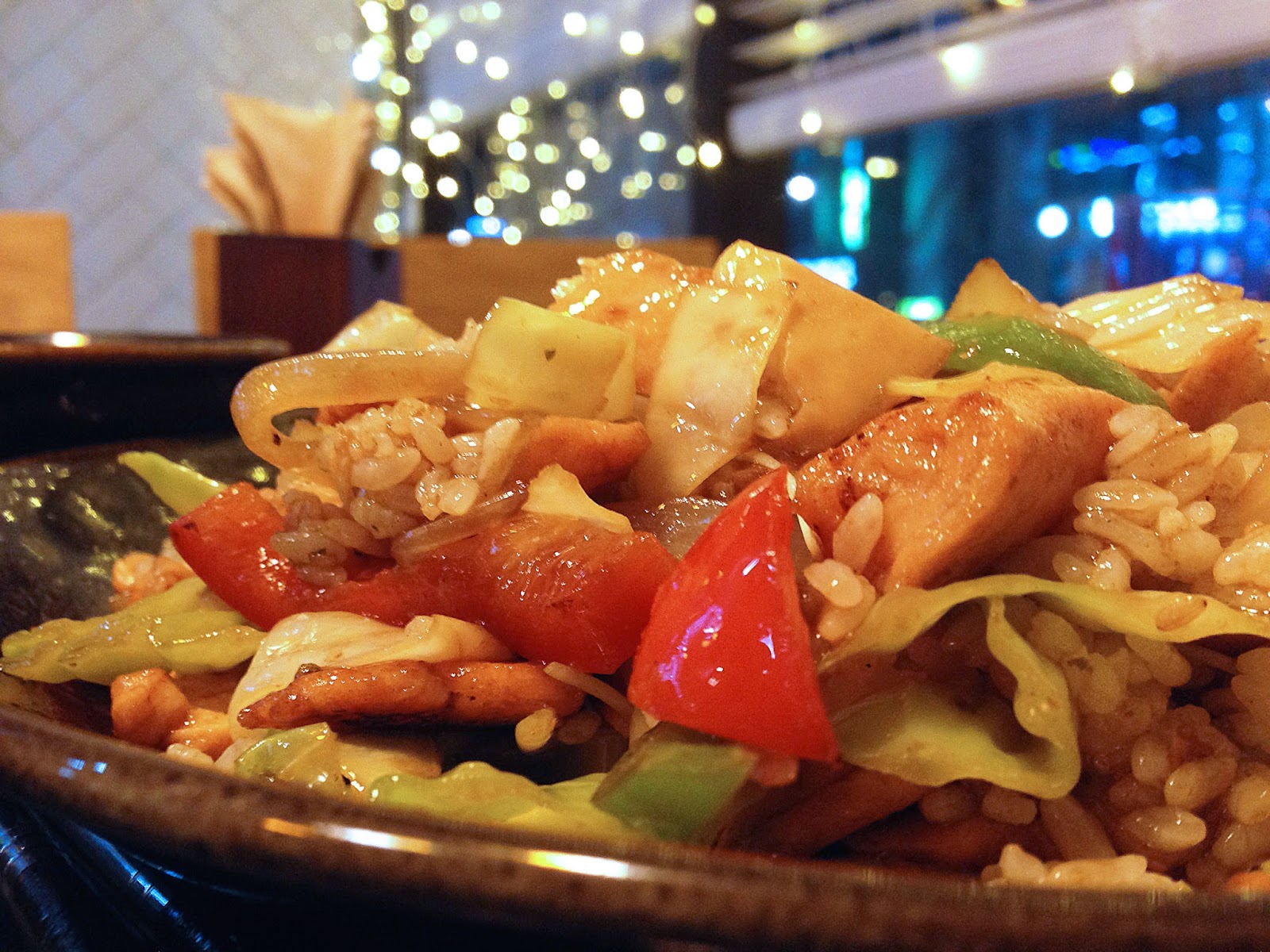
In addition to the donkas roll, another dish that stood out was the salmon teriyaki. If you google "salmon teriyaki" you get pages of delicious images of salmon steaks, so to be clear, Kazumori's salmon teriyaki is not a teriyaki salmon steak. It is a teriyaki salmon stir fry. This may be a creative twist or merely a labeling error. But either way, it is not just any salmon teriyaki. To be absolutely clear, it is an out of this world salmon teriyaki. The salmon is tender, but not flakey and dry. The veggies are all crisp and fresh. The NetBot went crazy over the mushrooms. And the teriyaki bound all the flavors together in perfect harmony. It was fantastic.

I can't say as much, however, about one of the side dishes served with our meals. Perhaps it is a perfectly conventional dish the humble NetBot and I are ignorant of, but it completely defied both our experiences, so we're chalking it up to the restaurant's creativity. And new or old, some ideas are better left under the toque. Included in our meals were cups of what appeared to be custard. It was exciting to imagine ending our meal with a custard, until an impatient NetBot took an early spoonful. It wasn't custard, at least not a dessert custard.

"I'm confused by it," said the NetBot. "I don't like it. It's not good. What is that? Fake crab meat?"


I tried to give it a chance. Sometimes food gets better the more you eat it. But it wasn't happening.

I will say this at least — it looked good.

Most of what Kazumori serves is really tasty, though. Their sushi was so good we went back the next week just for a salmon, or "yeon-eo," sushi set (연어초밥정식). We even ventured to taste gon-ee (곤이), a mild, buttery, intestine-looking fish-roe that we found at the bottom of our cod soup, daegu-tang (대구탕).

Prices were fair for what we ate. The first meal cost 19,000 won: 9,000 won for the sushi and donkas roll set (스시&돈가스롤정식), and 10,000 won for the salmon teriyaki set (연어데리야끼정삭). Our second meal was even more affordable: 7,000 won for the cod soup and 13,000 won for the salmon sushi set.

Kazumori is hard to miss. From Pyeongtaek Station take a bus to Pyeongtaek City Hall. Almost any bus will do, but you can always rely on the 50 or 20 bus which run frequently. Get off the bus in front of Lotte Mart (you'll see the store on your right) and continue by walking down the street. Look across the street when you get to the first intersection. You should see the Christmas lit windows of Kazumori on the second floor of a building across from you, in the building on the right of the Chevrolet/FX Hair building.


read more "Kazumori's Creative Pinch"